


Glenna Goodacre...
considered by many to be "America's Sculptor,"
is internationally renowned for her large-scale bronze figurative sculptures. Goodacre is credited with creating more than 500 sculptures thus far in her career. Galleria Silecchia is honored to present a major exhibition of her works. We invite you to experience her sculpture.
Though her career as an artist spans more than forty years, Glenna Goodacre's inspiration to sculpt began when she was thirty years old. Today her works are widely exhibited and displayed in public, national, international, municipal, corporate and private collections in more than forty countries.

Her public sculptures in America can be viewed in more than 25 of our United States. Some of her most significant commissions include the life-size bronze of President Ronald Reagan on view at The Ronald Reagan Presidential Library. Her portrait commissions include General Dwight D. Eisenhower, Greer Garson, Katherine Anne Porter and Scott Joplin.
And, on Veteran's Day, November 11, 1993, Goodacre's significant piece touched the lives of millions with the unveiling of the "VIETNAM WOMEN'S MEMORIAL." Located on the National Mall in Washington, DC, her sculpture, in both its design and breadth, honors and pays tribute to the eleven thousand American women who served in the military during the Vietnam War. The bronze maquette (small model) of the Vietnam Women Veterans Memorial is available at Galleria Silecchia.
Goodacre was commissioned to create "THE IRISH FAMINE MEMORIAL" for the City of Philadelphia having been selected from a competitive group of more than 100 international artists. The Irish Famine Memorial, a part of the 150th Anniversary of "The Great Hunger" in Ireland, features over 25 engaging life-size figures. This narrative sculpture is a dynamic arc of movement representing the process of immigration from famine in Ireland to hope in America. Goodacre's largest work to date, measures 12 feet high, 30 feet long and 14 feet wide; the east end depicts the lowest, blackest days, the very depths of the misery of starvation while, in contrast, the higher tilting west end portrays the figures arriving in America with hope and anticipation.
This important artistic and historical monument for Philadelphia was installed in October 2002 in the historic Penn's Landing district overlooking the Delaware River where many Irish immigrants disembarked when they came to Philadelphia. The bronze maquette of the Irish Famine Memorial is on view at Galleria Silecchia as are numerous studies of the life-size figures.


Glenna Goodacre's
work captures an essence of humanity that reaches out, touches us and draws us to it. "People can walk up and touch it," she says. "They want to look in the eyes. They want to think about it or smile."
"...To make art well is to raise life to its highest level and to live it at its best. For me, art is a means of satisfying both the imaginative and practical demand of life--both the form and the content must be right. Sculpture gives me a means of reaching a personal goal that exists just beyond the limits of my experience. It is a form of perfection that resides outside my power of attainment.
I have always preferred a realistic, academic and classical approach to sculpture, and have been totally absorbed with the figure and the head. This attitude has never varied. With the passing of time and the new experiences of each piece, I find myself more conscious of the representation of emotion with body language and facial expression. Guided by this concept, I am becoming less involved with detail and more conscious of composition, texture and design.
My success as a sculptor was not without difficulties, but every situation provided a learning opportunity. At the age of nineteen, I allowed a college sculpture professor to convince me that I should never attempt to make sculpture. That instructor insisted I could not see three-dimensional form and gave me an unsatisfactory grade for my efforts. In retrospect, I prefer to think that the ten years after that clash gave extra time to draw and learn basic figure proportions and anatomy.
As for the next twenty-five years, I can not see myself "retiring." I intend to make more sculpture and to grow with each piece realizing the wisdom gained by experience. I hope to spend more time on each piece, but I do not foresee a change in direction. I'll always enjoy sculpting children, different ethnic types, and designing interesting monuments. Accepting new challenges, stretching new ideas, doing only the work that excites me--that is my future. I am looking forward to the next twenty-five years." — Glenna Goodacre
Contact Galleria Silecchia for more on American bronze sculptor, Glenna Goodacre.

". . . In a career
that has spanned more than thirty years, Glenna Goodacre has formulated her belief in art into sculptures of heroic monuments, vivacious children, sensual nudes, and sensitive portraits.
Although most of her current work is three-dimensional, the relationship between painting and sculpture is present. Both are concerned with formal structure, directional force, and the movement of light across the surface of a figure. Certain pieces exemplify the dynamic nature of the subjects. However, it is the structural movement that becomes more apparent as the pieces are given closer consideration. Force and counter-force give energy and a sense of vitality to the figures. In all her sculpture, there is a strong pictorial quality. The dynamic energy held in classic repose is best exemplified in the Vietnam Women's Memorial. The nurse figures are captured in a split second of silence listening for the sound of incoming aircraft.
The intensity of anticipation documented by the listening figures is countered by the dramatic tableau of a fallen soldier and the comforting nurse against a backdrop of sand bags - a pieta' in battle dress. The extended hand of the soldier draws the viewer to the supporting figure and into the world of suspended animation. The force of the figures reflects the tragedy and heroism of the time and the expressive modeling gives the figures character and validity.
In the best traditions of figurative sculpture, Glenna Goodacre provides a means for the viewers to find their own way into and around the sculpture. Each person may discover a sense of identification with the figures, and intuitively anticipate a look, gesture, sign, or response. The messages each person receives are vintage Glenna Goodacre. The figures reflect her style…a style that is a means of giving a personal reality to the images . . ."
Gary Edson, Executive Director, Museum of Texas Tech University, May 1995
(Excerpt from: "Glenna Goodacre, The First 25 Years, A Retrospective Exhibition of Sculpture" published by the Museum of Texas Tech University.)

Published in 2009, Glenna Goodacre Sculpture celebrates Glenna's 40 years as a sculptor.
This rich, full-color monograph traces Glenna's varied career. With stunning photographs, complete lists of works, collections and commissions, this is a must have for the serious collector as well as the casual fan.
240-page coffee table book
autographed
complimentary shipping within mainland USA
Contact Galleria Silecchia for more on American bronze sculptor, Glenna Goodacre.
Goodacre Public Art
Glenna Goodacre is considered by many to be America's sculptor...


Sacagawea Golden Dollar Coin Released by the US Mint in January 2001
Goodacre's touching portrayal of Sacagawea was selected above 121 submissions by 23 other sculptors.
"SACAGAWEA"
Millennium Golden Dollar Coin produced by the US Mint, Washington, DC, USA
One of Goodacre's many contributions to America is her rendering of Sacagawea on the obverse side of the millennium golden dollar coin released into circulation by the US Mint in 2001.


"VIETNAM WOMEN'S MEMORIAL" in Washington, DC, USA
On Veteran's Day, November 11, 1993, Glenna Goodacre's sculpture touched the lives of millions with the unveiling of the Vietnam Women's Memorial at The Vietnam Wall on the National Mall in Washington, D.C. .


Photo by Patrick Hughes


Bronze Edition of 100
Created 1992
Revolving wood base
25h x 27w x 17d inches
$25,000

Bronze Edition of 100
Created 1992
Wood Base
9 x 9 x 6 inches
$ 7,500
At the Dedication Ceremony Glenna said:
"My desire to create a lasting tribute to the American woman serving in Vietnam is founded upon my deep respect for each of them, and my heartfelt prayer for their 'healing and hope'. I have been humbled by the enormity of such a task yet incredibly honored by the overwhelming gratitude of the veterans. The emphasis of this tribute is centered on their emotions: their compassion, their anxiety, their fatigue, and above all, their dedication.
My first concern in designing this sculpture was to arrange the four figures in a composition that is interesting from all angles: a true sculpture in the round. The photos from Vietnam often included stacks of sandbags. It seemed natural for a nurse 'in a moment of crisis' to be supported by sandbags as she serves as the life support for a wounded soldier lying across her lap. The standing woman looks up, in search of a med-i-vac helicopter or, perhaps, in search of help from God.
The kneeling figure has been called 'the heart and soul' of the piece because so many vets see themselves in her. She stares at an empty helmet, her posture reflecting her despair, frustrations, and all the horrors of war. The soldier's face is half-covered by a bandage, creating an anonymous figure with which veterans can identify. Even though he is wounded, he will live. I want this to be a monument for the living.
That my hands can shape the clay which might touch the hearts and heal the wounds of those who served fills me with humility and deep satisfaction. I can only hope that future generations who view the sculpture will stand in tribute to these women who served during the Vietnam era."
GLENNA GOODACRE
For information on the contributions made by American women and the Vietnam Women's Memorial VietnamWomensMemorial.org
"IRISH MEMORIAL" at Penns Landing, Philadelphia, PA, USA
Glenna Goodacre's Irish Memorial is installed in Philadelphia, PA. This monumental memorial was commissioned by the Philadelphia business community to commemorate the 150th Anniversary of the Great Hunger. Read the history of this amazing project.


An Irish Madonna was installed in April 2007 at University of Notre Dame in the Eck Visitor Center as a gift from Alumnus Frank O'Brien and his wife MaryBeth O'Brien in loving memory of their son Frank Edward O'Brien III.

Bronze Edition of 15
5 feet 10 inches high x 31" wide x 28" deep
call for availability
Link to Irish Memorial Sculpture

Bronze Edition of 50
9 x 20 x 10 inches
$ 24,000

Commissioned by and for the Ronald Reagan Presidential Libray, Simi Valley, CA, where it is permanentally installed
PARK PLACE...This wonderful bronze grouping spans "childhood to old age" and one complete set in the edition of 18 is installed in Talkington Park Plaza in Glenna Goodacre's hometown of Lubbock, Texas.

Bronze Edition of 18
6' h x 38' feet long
Complete set of all 5 sculptures sold out
Below are close-ups of the individual bronzes,two are available as individual acquisitions.

Bronze Edition of 18
72"H x 30"W x 30"
Sold Out Edition

Bronze Edition of 18
63"H x 44"W x 30"D
Sold Out Edition

Bronze Edition of 18
48"H x 24"W x 30"D
Sold Out Edition

Bronze Edition of 18
54"H x 31"W x 39"D
call for availability

Bronze Edition of 18
54"H x 40"W x 43"D
call for availability
"SIDEWALK SOCIETY" Permanently installed in 1991 at Albuquerque Plaza, Albuquerque, New Mexico, USA.

"I was commissioned to do a bronze for the entrance to the new Albuquerque Plaza. Because they requested something right on the walk, I wanted to do a piece that would be interactive with the visitors to the building. I did a quick clay sketch, then a maquette refining the individuals going about their daily activities. The 7' final bronze reflects a kind of cross section of people you find on any sidewalk in America." — Glenna Goodacre
SIDEWALK SOCIETY
Bronze Edition of 15
7' H x 24' L
Individual "Sidewalk Society" Pieces Available Shown Below...

LAST OF THE EDITION
Bronze Edition of 35
14"H x 26"W x 10"D

Bronze Edition of 35
6 H x 6"W x 12"D
$3,000
MAYO ANCESTORS PERMANENTLY INSTALLED
AT MAYO CLINIC, SCOTTSDALE AZ, USA
larger-than-lifesize (approximately 10 feet tall) on inscribed hexagaonal base
This limited-edition bronze sculpture-in-the-round was inspired by her recent larger-than-life-size commission for Mayo Clinic in Scottsdale, Arizona honoring the mission and achievements of a doctor father and his two doctor sons who where the Founders of Mayo Clinic. After the death of their father Dr. William Worrall Mayo in 1911, the brothers Dr. Charles Horace Mayo and Dr. William James Mayo, continued to evolve the clinic, founded on Sept 30, 1889, that revolutionized medicine and patient care into what would become the first and largest integrated, nonprofit medical group in the world.

Each physician holds a symbol of patient care, education and research: the three key elements of the Mayo Clinic mission, which the doctors Mayo supported throughout their long careers.


Given in gratitude to the Arizona campus of Mayo Clinic by Laree E. Perez of Scottsdale, Arizona and Yeso, New Mexico, And Paulette and Joe Maslick of Scottsdale, Arizona and Chicago, Illinois, to honor the mission and achievements of...
WILLIAM WORRALL MAYO, MD
Specialized in Patient Care
1819-1911
WILLIAM JAMES MAYO, MD
Specialized in Research
1861-1939
CHARLES HORACE MAYO, MD
Specialized in Education
1865-1939
"The best interest of the patient is the only interest to be considered, and in order that the sick may have the benefit of advancing knowledge, union of forces is necessary."
Dr. William James Mayo
"There are two objects of medical education: to heal the sick, and to advance the science. Medicine is both an art and a science, and both make appeal to the true physician."
Dr. Charles Horace Mayo

Available
$ 550,000

"I sculpted a small 24 inch Pledge of Allegiance as a gift to First Lady Barbara Bush from the Denver Children's Museum. I had many requests for a life-size version, and it was a challenge to put life and action into such a static situation. It was a very popular edition in America. Also, one bronze casting is in Japan and another in Brazil."
(excerpt from "Glenna Goodacre: The First 25 Years")
Contact Galleria Silecchia for complete information on the works of American bronze sculptor, Glenna Goodacre.
Retrospective of Sold Out Editions
This section chronicles a sampling of sold-out editions of Glenna Goodacre's sculpture. While this is in no means a complete catalog of Goodacre's sold-out work, if you are interested in acquiring a sold-out piece, please contact us for availability.

Bronze Edition of 15
Created 1989
Special unique inscription on the back of the flying scarf,
"For Children of All Ages, Love, Glenna"
Lifesize 6 feet high x approx 12 feet wide
Sold Out Edition

Bronze Edition of 40, Created 1999
24 x 12 x 15 inches
Sold Out Edition


SILVER SARAH
Unique Sculpture
Silver on Marble Base, Created 1983
8 x 3.5 x 3.5 inches
Sold Out Edition

Bronze Edition of 50, Created 1995
14 high x 23 wide x 10 deep inches
Sold Out Edition

Created 1995
Bronze on Revolving Walnut Base
14 x 7 x 7 inches
Sold Out Edition

Side View

Bronze Edition of 25,
Created 2002
Bronze on Black Granite Base
7 x 13 x 12 inches
Sold Out Edition

Bronze Edition of 25
17 x 9 x 9 inches

Bronze edition of 30
Created 1982
17 x 18 x 14 inches
on revolving wood base
Sold Out Edition

Bronze Edition of 1
15.5 inches
Sold Out Edition

Bronze Edition of 1
18 inches
Sold Out Edition

Created 1995
Bronze on Revolving Wood Base
18.5 x 9 x 10 inches
Edition is sold out


TABLE WITH BEVELED GLASS TOP
3-FIGURES
Bronze Limited Edition of 25
32 x 21 x 21 inches
Sold Out Edition

Bronze Edition of 35
Created 1991
14 x 26 x 10 inches
$ 18,000
Click link below for view in the round
SIDEWALK SOCIETY Alternate View


Created 1992
Bronze on Revolving Walnut Base
15 x 5 x 5 inches
Edition is Sold Out


Bronze Edition of 35
Ceated 1987
Bronze on Walnut Base
16 x 20 x 9 inches
Sold Out Edition

Bronze Edition of 50
Created 1999
44 inches
Sold Out Edition
READ ARTICLE:
Spotted Tail Goes to Washington

Bronze Edition of 40
Created 1999
20 x 18 x 18 with revolving wood base
Sold Out Edition
DEPARTURE FROM DUBLIN Alternate View


Bronze Edition of 25
Created 2002
23 x 15 x 15 inches
walnut insert on distressed walnut pedestal
46 x 12 x 12
Total height on pedestal is 69 inches
Sold Out Edition

Bronze Edition of 25
Created 1998
14"H x 10"W x 14"D
Sold Out Edition

Created 2000
Bronze Edition of 300
8 x 3 x 3 inches
Sold Out Edition

Wall Sculpture
Bronze Edition of 200
7 x 7 x 1
Sold Out Edition


RIO
FROM PARK PLACE GROUP - OLD MAN AND DOG SCULPTURE
Bronze Edition of 25
Created 2001
Brown patina available
23"h x 11w x 25"d
call for availability


MAYO ANCESTORS MAQUETTE 1/25
3-sided sculpture-in-the-round
Dr. William Worrall Mayo and his sons Dr. William Mayo and Dr. Charles Mayo,
Founders of Mayo Clinic
Bronze Edition of 25
Bronze with Inscribed Hexagonal Bronze Base on Revolving Wood on Pedestal
33 x 20 x 20 inches
SOLD OUT EDITION
3-SIDES SHOWN IN THE ROUND

We are honored to announce the release of Mayo Ancestors Maquette from the Studio of Glenna Goodacre. This limited-edition bronze sculpture-in-the-round was inspired by her recent larger-than-life-size commission for Mayo Clinic in Scottsdale, Arizona honoring the mission and achievements of a doctor father and his two doctor sons who where the Founders of Mayo Clinic. After the death of their father Dr. William Worrall Mayo in 1911, the brothers Dr. Charles Horace Mayo and Dr. William James Mayo, continued to evolve the clinic, founded on Sept 30, 1889, that revolutionized medicine and patient care into what would become the first and largest integrated, nonprofit medical group in the world.
MAYO ANCESTORS PERMANENTLY INSTALLED
AT MAYO CLINIC, SCOTTSDALE AZ, USA
larger-than-lifesize (approximately 10 feet tall) on inscribed hexagaonal base

Bronze Edition of 50
Created 2007
11 x 9.5 inches
Sold Out Edition

Bronze Edition of 50
Created 2003
7 x 4 inches
Sold Out Edition

MONDAY
Cast Resin Relief Wall Scupture
Edition of 25
34 x 56 x 9 inches
Sold Out Edition
The lightweight nature of the resin material used for MONDAY allows
this beautiful piece to be hung on virtually any interior wall.

Created 1984
Bronze on Walnut Base
14.5 x 8.5 x 8 inches
Sold Out Edition
CHELSEA Alternate Side View


Created 1986
Bronze Edition of 15
26 x 14 x 11 inches
Sold Out Edition

PARK PLACE
AERIAL VIEW - COMPLETE LIFESIZE SET OF 5 BRONZES SOLD OUT
4 OF THE 5 BRONZES STILL AVAILABLE
LATERAL VIEW OF PARK PLACE BELOW - CLICK TO ENLARGE

PARK PLACE
Bronze Edition of 18
6' h x 38' feet long
Complete Set Is Sold Out
"PARK PLACE" - This work is installed in Talkington Park Plaza in Glenna Goodacre's hometown of Lubbock, Texas. It was available as a five sculpture grouping with either a winding bench, as shown below, or with an individual bench for each sculpture in the group. Two sculptures are individually available.


Bronze Edition of 18
48"H x 24"W x 30"D
Sold Out Edition

Bronze Edition of 18
72"H x 30"W x 30"
Sold Out Edition

From Park Place
Bronze Edition of 18
Created 1998
54"H x 31"W x 39"D
call for availability
WALL STREET JOURNAL Close-up

"PARK PLACE" - This 5 piece sculpture is installed in Talkington Park Plaza in Glenna Goodacre's hometown of Lubbock, Texas. It was available as a five sculpture grouping.
Two sculptures are individually available.

CEO
LARGER-THAN-LIFESIZE From Sidewalk Society
Bronze Edition of 15
Created 1991
75"H x 29"W x 33" D
Sold Out Edition

CHRISTINA TERRA COTTA
Wall Relief Sculpture
(can also be displayed in a stand)
Terra Cotta Open Edition
11 x 11 x 1 inches
Sold Out
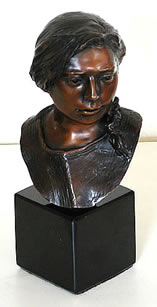
MARIA 56/75
Bronze Edition of 75
Created 1995
Marble Base
10 x 4 X 5d inches
Sold Out Edition

SIOUX DIPLOMAT
Bronze Edition of 50
16.75 x 7 x 8d inches
Sold Out Edition

RANGEHAND
Bronze Edition of 50
16 x 7 x 9d inches
Sold Out Edition

BUFFALO MAIDEN
Bronze Edition of 2, Created 2015
Bronze Relief
20 x 14 X .5 inches
Sold Out Edition

BUFFALO DANCER
Bronze Edition of 1, Created 2015
Bronze Relief
46 x 21 x .5 inches
Sold Out Edition

BUFFALO DANCE
Resin Wall Sculpture
Edition of 35
4 feet high x 6 feet wide x 4 inches deep
Sold Out Edition

WAITING TO DANCE
Bronze Edition of 35
38 inches high including walnut
and stone turntable base
Sold Out Edition

FLOWER GIRL
Bronze Edition of 35
with Marble and Wood Base
22 x 13 x 13d inches
Sold Out Edition

SUKI
Bronze Edition of 25
Marble Base
23 x 8 x 8d inches
Sold Out Edition
Contact Galleria Silecchia for more on American sculptor, Glenna Goodacre.
The Irish Memorial Project History
To commemorate the 150th Anniversary of the Great Hunger, a committee of prominent Philadelphians from business, government, and the arts commissioned a monument to the Irish who perished and to those who survived, immeasurably enriching the history and culture of the United States. This monument is called the Irish Memorial.
In a 1997 international competition, Santa Fe artist Glenna Goodacre was unanimously selected as the winning sculptor for the Irish Memorial. On March 13, 2000, the Irish Memorial Committee held a ceremonial contract signing for the monument's commission. This event, which took place at the Plough and the Stars Restaurant in Philadelphia, marked the official beginning of the project, and Goodacre received the first installment of her payment. She then embarked upon sculpting the Irish Memorial, which was a two year project. The piece was permanently installed in early February 2003 and the formal dedication occurred in October 2003 with the completion of the surrounding park.
The Great Hunger was a tragedy that led to the single greatest loss of life in Europe between the Napoleonic Wars and World War I. The Irish potato famine began in 1845 and affected other European countries. But in Ireland, the crisis took place in an economic, political, and social framework that was oppressive and unjust. Ireland and her people endured a disproportionate share of suffering.
When the blight struck, 75 percent of Ireland's tillable land was devoted to growing grains, such as barley, corn, oats and wheat, almost all of which was exported. Likewise, the cattle, pigs and sheep were not eaten by the Irish but sent to Great Britain. All of this food was sufficient to feed the Irish people several times over. Because of the mandatory exporting, as well as an 1847 British legislation that facilitated eviction of Irish tenants by their landlords, a million Irish starved to death, and another million were forced to flee Ireland. This amounted to the loss of almost a quarter of that country's population.
The Irish immigrated to the British Isles, Australia, Canada, the United States and elsewhere. The overwhelming immigration was to North America.
Those who managed to survive the "coffin ships" bound for North America did not receive a warm welcome. They became America's urban poor and were quickly identified with disease, alcohol abuse and crime. However, these entry-level laborers helped build railroads, dig canals, mine coal, and foster the growth of cities, states and the nation. Many Irish went on to make significant contributions in the fields of business, education, industry, government, medicine, science, religion and the arts.Today, more than 44 million Americans claim Irish heritage.


This major monument stands in downtown Philadelphia at Front and Chestnut streets. (MAP) The l 3/4-acre national site is a public park that overlooks the Delaware River at historic Penn's Landing, a fitting location because many of the Irish disembarked along those shores. This massive bronze is Goodacre's most ambitious public sculpture - with over 25 life-size figures. The silicon bronze that was used is particularly resilient and the dark patina with a touch of green will grow deeper over the years. A majestic landscaped garden surrounds the sculpture ... continued

This monumental bronze is designed as a dynamic arc filled with movement. Approximately 12 feet high, 30 feet long and 12 feet wide, the sculpture rests on a concrete plinth 2 feet high with the basic profile of a large wedge. The monument's flow depicts the famine in Ireland, the people embarking for America, and the immigrants stepping onto American shores. The east end, suggests a landscape, portraying the misery of the Irish Starvation. In contrast, the higher end, suggests a ship, facing west as anxious immigrants dock in America and a number of figures rush forward in hope and anticipation. For this sculpture in the round, all of the figures are in period dress but they are loosely modeled and impressionistic.
From more than 100 artists, Goodacre was chosen to sculpt the Irish Memorial not only because of her dynamic design but also because she best expressed the mission and objective of the memorial.
Goodacre's ability to capture emotion in sculptural form has been honed over several decades of an award-winning career.
For more than a decade, Goodacre has been a participant in the Art in Embassies program, exhibiting work worldwide.
The most recognized of her completed public monuments is the Vietnam Women's Memorial in Washington, D.C. Goodacre has more than 40 bronze portraits in public collections, including sculptures of Ronald Reagan, Dwight D. Eisenhower, Greer Garson, and Scott Joplin. In 2000, Goodacre's rendering of Sacagawea, the interpreter for Lewis and Clark, appeared on the face of a new dollar coin issued by the U.S. Mint.
An academician
of the National Academy of Design since 1994 and a fellow of the National Sculpture Society since 1981, she has won many awards at their exhibitions in New York.
Much earlier in her career, Goodacre studied in New York at the Art Students League. More recently, she received honorary doctorates from Colorado College, her alma mater, and Texas Tech University in her hometown of Lubbock, Texas.
As part of an initiative in the Philadelphia school district, as well as in other school districts throughout the country, the Irish potato famine has been recently added to the history curriculum. Philadelphia's "IRISH MEMORIAL" gives a stirring visual presentation, coupled with substantial historical data, to complement the school curriculum.
The memorial is truly an educational experience.
Contact Galleria Silecchia for more on American bronze sculptor, Glenna Goodacre.


"Inspirations" Irish Catalog

IRISH MADONNA
Bronze Edition of 11
69"H x 31"W x 28"D

TINY MADONNA
Edition of 200
5"H x 1 1/2"W x 1 1/2"D

IRISH MADONNA
Closeup View

TESS
Bronze Edition of 25
9"H x 8"W x 3"D
Sold Out Edition

PATRICK AND SHANNON
Bronze Edition of 25
15"H x 17"W x 14"D
granite insert on pedestal
46"H x 12W" x 12D"
Total height mounted on pedestal is 61"H
Sold Out Edition

PETER
Bronze Edition of 25
22"H x 13"W x 14"D
granite insert on pedestal
46"H x 10W" x 10D"
Total height mounted on pedestal is 68"H
Sold Out Edition

DAPPER GENT
Bronze Edition of 25
13"H x 13"W x 12"D
granite insert on pedestal
46"H x 10W" x 10D"
Total height mounted on pedestal is 59"H
Sold Out Edition

JOHN LAWLESS
Bronze Edition of 25
18"H x 11"W x 10"D
granite insert on pedestal
46"H x 12W" x 12D"
Total height mounted on pedestal is 64"H
Sold Out Edition

SEAN
Bronze Edition of 25
19"H x 9"W x 9"D
red butterscotch patina on granite insert on pedestal
46"H x 10"W x 10"D
Total height mounted on pedestal is 65"H
Sold Out Edition

WIDOWER
Bronze Edition of 25
23"H x 13"W x 14"D
granite insert on pedestal
46"H x 10W" x 10D"
Total height mounted on pedestal is 69"H
Sold Out Edition

FINNEGAN
Bronze Edition of 25
22"H x 12"W x 12"D
granite insert on pedestal
46"H x 10W" x 10D"
Total height mounted on pedestal is 68"H
Sold Out Edition

MOLLY
Bronze Edition of 25
18"H x 10"W x 11"D
on granite base
Sold Out Edition

LOUIE
Bronze Edition of 25
17"H x 13"W x 13"D
slate insert on pedestal
46"H x 10W" x 10D"
Total heighmounted on pedestal is 63"H
Sold Out Edition

LIAM
Bronze Edition of 25
18"H x 9"W x 8"D
with granite insert on pedestal
46"H x 10W" x 10D"
Total height mounted on pedestal is 64"H
Sold Out Edition

MONA
Bronze Edition of 25
21"H x 17"W x 15"D
granite insert on pedestal
46"H x 10W" x 10D"
Total height mounted on pedestal is 67"H
Sold Out Edition

VAGABOND
Bronze Edition of 25
18"H x 13"W x 10"D
granite insert on pedestal
46"H x 12W" x 12D"
Total heightmounted on pedestal is 64"H
Sold Out Edition

BRIDIE
Bronze Edition of 25
20"H x 14"W x 16"D
granite insert on pedestal
46"H x 12W" x 12D"
Total height mounted on pedestal is 66"H
Sold Out Edition

ANGUISH
Bronze Edition of 25
17"H x 12"W x 13"D
with honed granite insert
on pedestal
46"H x 10W" x 10D"
Total height mounted on pedestal is 63"H
AVAILABLE
$ 9,000

FATHER O'MALLY
Bronze Edition of 25
19"H x 14"W x 14"D
black patina on granite insert
46"H x 10"W x 10"D on pedestal
Total height mounted on pedestal is 65"H
Sold Out Edition

BERNADETTE
Bronze Edition of 25
22"H x 13"W x 12"D
granite insert on pedestal
46"H x 12W" x 12D"
Total height mounted on pedestal is 68"H
Sold Out Edition

MR. O'TOOLE
Bronze Edition of 25
21"H x 12"W x 12"D
granite insert on pedestal
46"H x 12W" x 12D"
Total height mounted on pedestal is 67"H
Sold Out Edition
Contact Galleria Silecchia for more on American bronze sculptor, Glenna Goodacre.